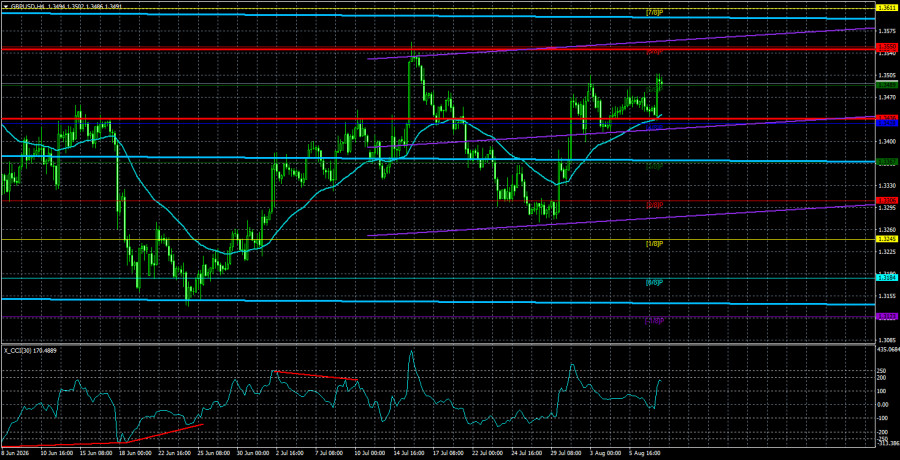
The GBP/USD currency pair also showed an upward movement on Friday, but it was quite weak. The volatility was only 74 pips, which is extremely low for such an important day and important data. Recall that on Friday, the impactful and disappointing Non-Farm Payroll report was released. The figure for July was "only" 100,000 below expectations and in negative territory. The values for May and June were revised downward by 100,000. Thus, the US labor market effectively lost 200,000 jobs, and jobs are not being created; they are being cut. We believe the market's reaction could have been much stronger, and the dollar should have depreciated more.
However, the Non-Farm Payroll report is now in the past. It has significantly reduced the probability of tightening monetary policy not only in September but throughout the rest of the year, as we have warned several times. Therefore, the market now has to abandon its "hawkish" views and expectations. This week, another important inflation report will be published in the US. According to official forecasts, the Consumer Price Index (CPI) may slow to 3.4%, but we believe the disinflation process will be more pronounced. In any case, if inflation drops compared to June, that counts as disinflation. Now the question is: why would the Federal Reserve raise rates in September if inflation is falling?
We still believe that Kevin Warsh is not inclined to tighten monetary policy, and the market has completely forgotten that Trump appointed Warsh to lower the key rate. Of course, Warsh cannot change the key rate as Trump would like him to. However, he is still the head of the Fed. He undoubtedly influences other members of the FOMC.
Thus, we do not see macroeconomic grounds for raising the rate, and the geopolitical backdrop has definitively passed the phase of active hostilities, so the dollar cannot rely on such support. From a technical standpoint, the GBP/USD pair continues to move from the lower boundary of the consolidation channel on the weekly timeframe to the upper boundary, and the four-year upward trend remains intact. The macroeconomic situation in the US is failing, which means it will not support the US currency. Almost all factors indicate that the euro and the pound are likely to continue rising. Unless, of course, the market ignores all the aforementioned factors, which is also a possibility.
Next week, a relatively important UK GDP report for the second quarter will be released, but we think all traders fully understand the basis on which the GBP/USD exchange rate is currently forming. This report may provoke only a small reaction. It is also worth noting that volatility has dropped significantly in recent weeks. Over the past 30 days, the average value stands at just 75 pips, and over the last 5 days—it's even lower.
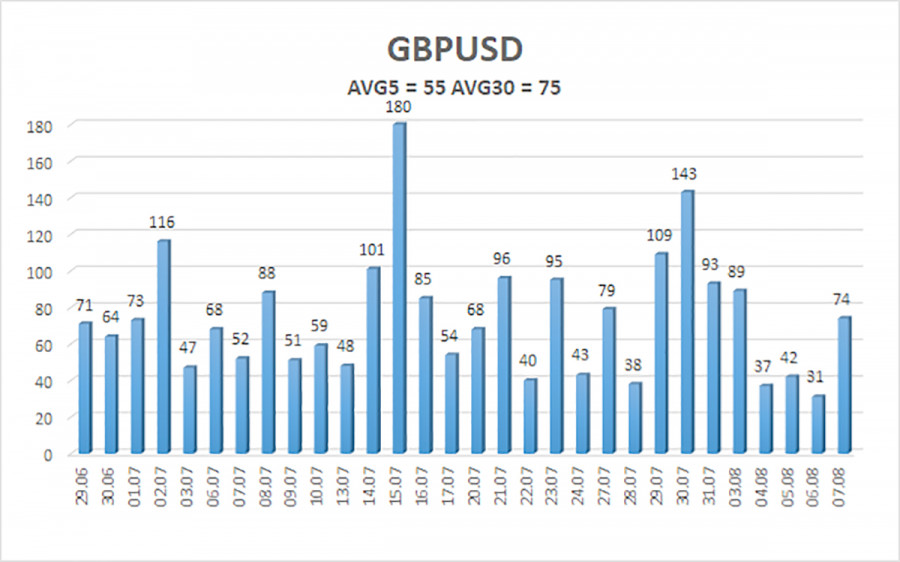
The average volatility of the GBP/USD pair over the last five trading days, as of August 10, is 55 pips, which is considered "medium-low" for this pair. On Monday, August 10, we expect movement within the range bounded by 1.3436 and 1.3546. The upper linear regression channel points downward, indicating a prevailing downtrend. The CCI indicator has entered the overbought territory, which may trigger a new downward correction.
S1 – 1.3489
S2 – 1.3428
S3 – 1.3367
R1 – 1.3550
R2 – 1.3611
R3 – 1.3672
The GBP/USD pair maintains an upward trend. Donald Trump's policies will continue to put pressure on the US economy, so we do not expect long-term growth in the US dollar. The year 2026 is proving super-positive for the dollar due to geopolitical factors, but every fairytale eventually comes to an end. The weekly timeframe remains in a flat pattern between 1.3150 and 1.3780, consistent with a four-year upward trend, supporting the expectation of continued growth in the British currency in the medium term. Long positions with targets at 1.3550 and 1.3611 can be considered when the price is above the moving average. If the price is below the moving average line, bearish trades can be executed with targets at 1.3367 and 1.3306.

QUICK LINKS
ForexMart is authorized and regulated in various jurisdictions.
(Reg No.23071, IBC 2015) with a registered office at First Floor, SVG Teachers Co-operative Credit Union Limited Uptown Building, Corner of James and Middle Street, Kingstown, Saint Vincent and the Grenadines
Restricted Regions: the United States of America, North Korea, Sudan, Syria and some other regions.








 Contact Us