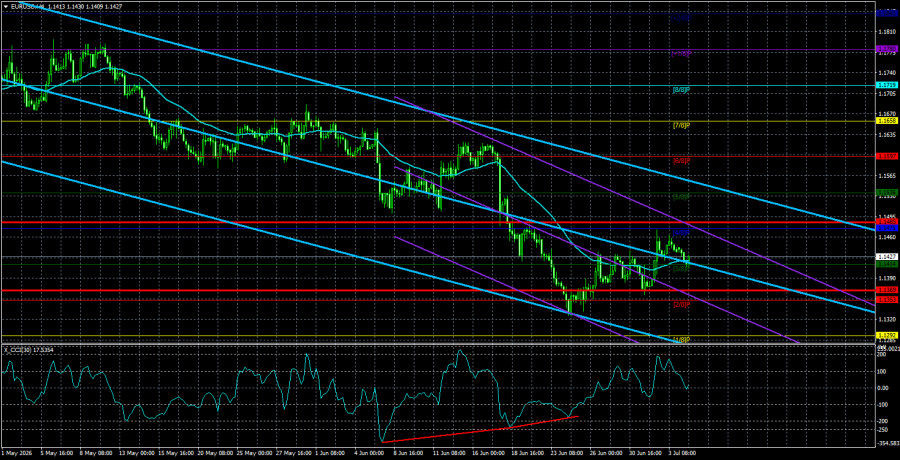
The EUR/USD currency pair showed no interesting movements on Monday, which is not surprising given the virtually empty event calendar. As we warned, there was nothing for the market to react to on Monday, so it essentially comes down to when the next "black swan" will emerge. Over the past two months, the dollar has been thriving. The market is buying it as if the Federal Reserve has already raised the key rate three times, and the conflict in the Middle East is ongoing as if nothing has changed. In the past week and a half, the euro has corrected slightly, but this correction is laughably small. The market continues to ignore many factors that favor the European currency. Therefore, overall, we remain of the opinion that the market is undergoing illogical, inertial, and speculative movement. This cannot yet be considered complete.
What could stop this movement? In reality, only a refusal by traders to buy the U.S. dollar could impact the market, and this may not be linked to either fundamental or macroeconomic events. Following the Fed's meeting on June 17, experts uniformly predicted forthcoming tightening in monetary policy, which was cited as the main reason for the dollar's rise. The European Central Bank's rate hike has not attracted interest and still does not. Time is passing, and the Fed has fewer and fewer reasons to raise rates in 2026. First, the labor market is contracting again. Second, inflation, under pressure from falling oil prices, could slow in the coming months even without regulatory intervention. Third, Donald Trump is once again demanding a rate cut from the Fed. Fourth, Kevin Warsh (if anyone does not remember) is a Trump protege who was brought in to lower rates, not to raise them.
Thus, no matter what Warsh says at the press conference on June 17, we simply do not believe it. If U.S. inflation in June does not decrease, the probability of a policy tightening in the U.S. will indeed become high. Such a "reverence" would mean that American prices are not responding to falling energy costs—or do not want to respond. After all, prices depend on businesses, producers, sellers, and service providers. If all these parties continue to raise prices at previous rates, then the Fed will have to intervene. However, as practice shows, prices usually do not respond immediately to changes in oil market prices but do so over a period of 3-6 months. Therefore, inflation could potentially slow down over the next six months.
The new inflation report will be released on July 14 and will answer the question of whether the Fed can be expected to tighten policy, at least in the fall. Already, a slowdown in consumer prices to 3.9% is being forecasted. However, until July 14, forecasts may become even lower. Thus, a slowdown in inflation not only casts doubt on even a single rate hike by the Fed but also removes the last remaining advantage of the dollar, which continues to extract every ounce from the market. In our view, sooner or later, the illogical rise of the dollar will stop. We currently see insufficient grounds for its continuation.
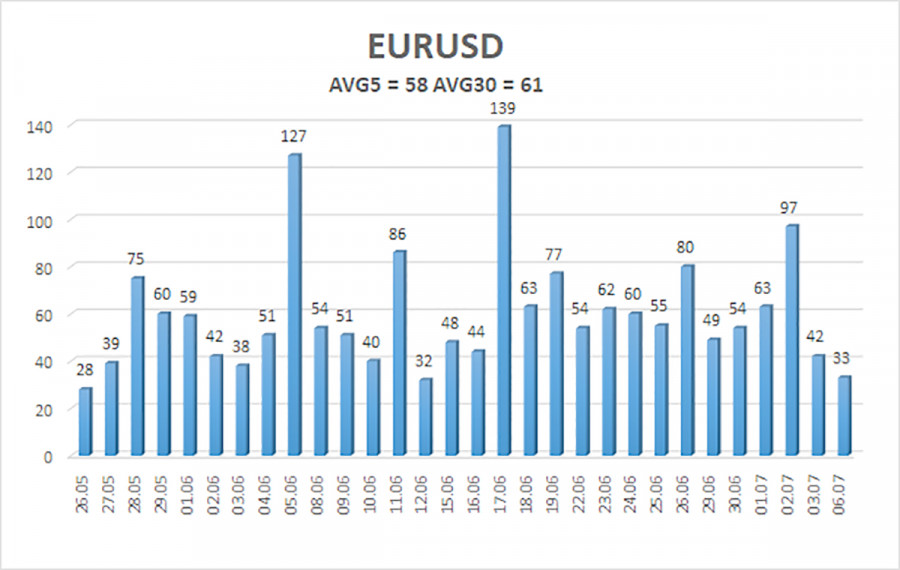
The average volatility of the EUR/USD currency pair over the past five trading days as of July 7 is 58 pips and is characterized as "average." We expect the pair to move between 1.1369 and 1.1485 on Tuesday. The upper channel of the linear regression has turned downwards, indicating the continuation of the downward trend. The CCI indicator has entered the oversold area and formed two "bullish" divergences, warning of a possible end to the downward trend.
The EUR/USD pair retains a downward trend, presumably a correction within a global upward trend, as is clearly seen on the daily or weekly timeframe. The overall fundamental backdrop for the dollar remains negative, but in 2026, geopolitics first, then the Fed's hawkish stance, provided significant support for the American currency. When the price is below the moving average, short positions can be considered with targets at 1.1353 and 1.1292. Above the moving average line, long positions are relevant with targets at 1.1485 and 1.1536. Bears are currently very strong for no visible reason.
QUICK LINKS
ForexMart is authorized and regulated in various jurisdictions.
(Reg No.23071, IBC 2015) with a registered office at First Floor, SVG Teachers Co-operative Credit Union Limited Uptown Building, Corner of James and Middle Street, Kingstown, Saint Vincent and the Grenadines
Restricted Regions: the United States of America, North Korea, Sudan, Syria and some other regions.








 Contact Us