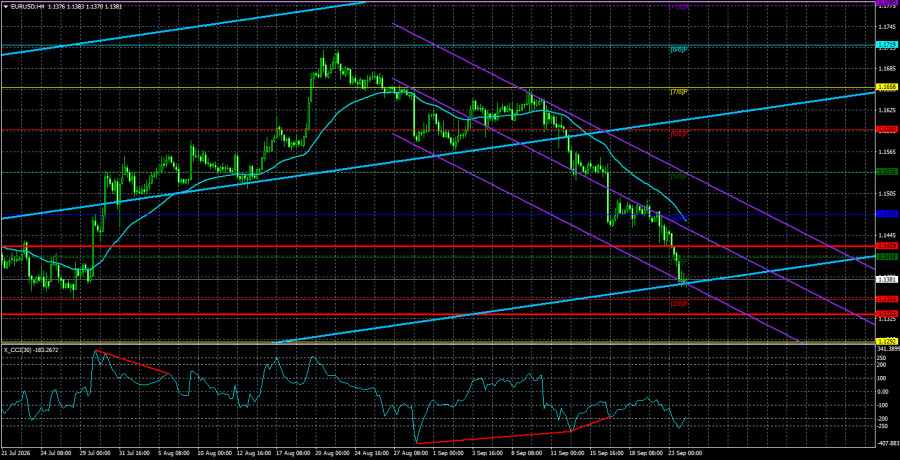
The EUR/USD pair continued its downward movement on Wednesday. For three weeks in a row, the European currency has been declining, which could be driven by only one event and factor — the Federal Reserve's monetary policy tightening. Essentially, one can now say the same thing every day. Did the dollar rise? That means the market continues to buy the US currency amid the Fed's hawkish monetary stance. How much longer the dollar will rise on the same factor is unknown. In principle, we noted several weeks ago that the dollar's rise looks illogical. The point is that the market priced in Fed tightening several times over the summer. Immediately after Kevin Warsh's first meeting as Fed chair, the market rushed to buy the dollar because Warsh announced his intention to fight high inflation, contrary to the common belief that he would follow White House directives. As we've seen, those who thought so were wrong, but that doesn't change the fact that the Fed has raised the key rate only once so far, while the dollar rose in June, rose in July, and has been rising throughout September on the back of this factor.
Is it worth saying that there were no strong local reasons for the pair's new decline on Monday, Tuesday or Wednesday? Yes, several members of the Fed's policy committee said this week that inflation remains too high, so the central bank will likely have to continue tightening policy. But if the Fed intends to raise the key rate once more and no one says it out loud — that is the same as if the Fed raised the rate once and every Fed representative talked about it every day. In other words, constant statements about the need to tighten will not make the Fed raise rates more times. The September decision to tighten was unanimous. Thus, all 12 Fed officials with voting rights can now talk every day about high inflation and tightening policy. Will the dollar rise each time?
The market pays no attention to routine, banal macroeconomic data. Yesterday, the EU and Germany published fairly important September business activity indices for services and manufacturing. Most of these indices came in higher than forecast. Did this help the euro in any way? Rhetorical question. If the market ignores the European Central Bank's monetary tightening, it will ignore other eurozone data. How fair is this? Judge for yourself. How logical is it? Not logical at all.
We should also note that most experts are now disregarding inconvenient facts. In other words, why analyze events that should strengthen the euro but don't, when you can pick convenient events that explain the almost daily rise of the US dollar? We consider the current movement illogical, and in this format, the dollar can rise to any level. Why not, if fundamentals, macroeconomics, and geopolitics have no significance for the market?
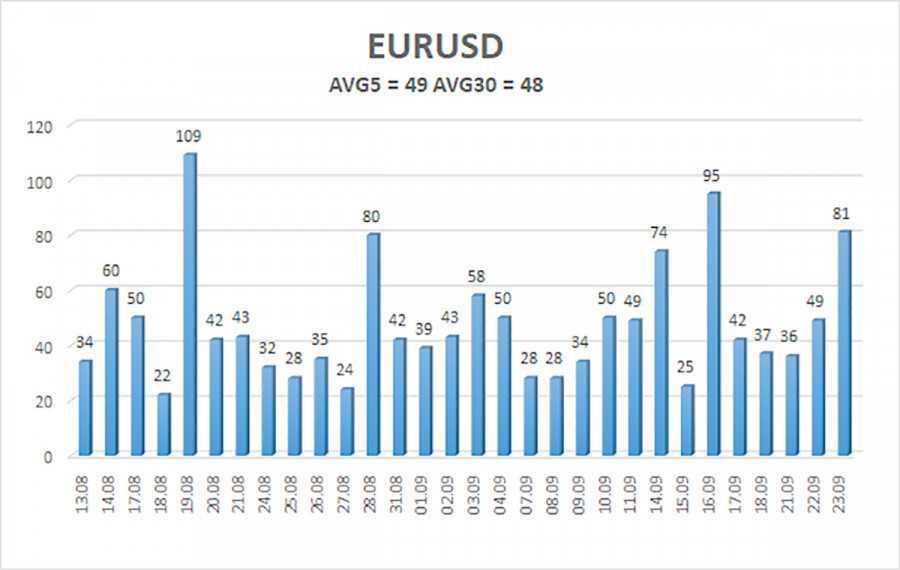
The average volatility of the EUR/USD currency pair over the last 5 trading days as of September 24 is 49 pips and is characterized as "average." We expect the pair to move between 1.1331 and 1.1429 on Thursday. The higher linear regression channel is pointing upward, indicating an uptrend. The CCI indicator entered the oversold area three times and formed two "bullish" divergences, which warn of the end of the illogical downward correction.
S1 – 1.1353
S2 – 1.1292
S3 – 1.1230
R1 – 1.1414
R2 – 1.1475
R3 – 1.1536
The EUR/USD pair continues to move downward, but we still view the pair's decline as a correction before a new upward trend. The global fundamental backdrop for the dollar remains negative, but in 2026, geopolitical events first, and then the Fed's hawkish stance, provided strong support to the US currency. When the price is below the moving average, consider short positions with targets of 1.1353 and 1.1331. Above the moving average, long positions are relevant, with targets of 1.1536 and 1.1597.
Regression channels help determine the current trend. If both are directed in the same direction, it means the trend is currently strong;
The moving average line (settings 20,0, smoothed) defines the short-term trend and the direction in which trading should be conducted at present;
Murray levels are target levels for moves and corrections;
Volatility levels (red lines) are the probable price channel within which the pair will spend the next 24 hours based on current volatility indicators;
The CCI indicator – its entry into the oversold area (below -250) or the overbought area (above +250) indicates that a trend reversal in the opposite direction is approaching.
LINKS RÁPIDOS
ForexMart is authorized and regulated in various jurisdictions.
(Reg No.23071, IBC 2015) with a registered office at First Floor, SVG Teachers Co-operative Credit Union Limited Uptown Building, Corner of James and Middle Street, Kingstown, Saint Vincent and the Grenadines
Restricted Regions: the United States of America, North Korea, Sudan, Syria and some other regions.









 Contate-nos