The wave structure on the 4-hour EUR/USD chart has become more complex. On the higher timeframe (bottom chart), the downward trend segment has taken the form of a five-wave structure
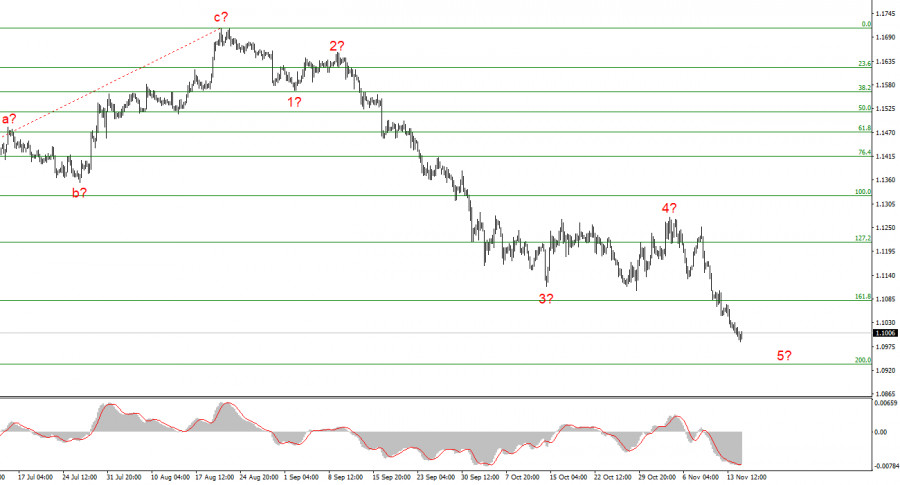
The wave structure on the 4-hour EUR/USD chart has become more complex. On the higher timeframe (bottom chart), the downward trend segment has taken the form of a five-wave structure labeled A-B-C-D-E. This structure could be completed at any moment, as it appears to be fully developed. All the waves within this segment are approximately equal in size, which is why it is considered corrective. If this assumption is correct, a new upward impulsive trend segment will begin once the structure is complete, with targets located well above the 1.2000 level.
On the lower timeframe (top chart), the formation of an impulsive wave sequence is continuing, which may belong to wave E of the higher timeframe. If this is indeed the case, the dollar's strengthening is nearing its end, regardless of how strongly the US currency may continue to rise. The expected wave 5 of E is approaching completion. In any case, the current wave structure suggests that the formation of the downward wave sequence is nearing completion on both charts. The news flow and the sharp shift in market sentiment triggered a strong rally in the US dollar, but there are few new reasons left to support further dollar appreciation.
The EUR/USD exchange rate declined by another 30 basis points on Monday, which was fully consistent with the news flow throughout the day. The European Union's industrial production report showed relatively weak figures and once again disappointed euro buyers. As previously noted, positive news for the euro also reaches the markets from time to time, but traders still prefer to focus on the main factor: the tightening of Fed policy.
Last week, the release of the US inflation report triggered a sharp increase in hawkish expectations. Market participants began to consider the possibility that the Fed could implement three rounds of policy tightening at its next three meetings. The statements made by Christopher Waller and Mary Daly also contributed to the sharp increase in hawkish expectations. Waller indicated that a 50-basis-point rate hike in December was possible, while Daly suggested that the rate-hiking cycle could continue for longer. As previously noted, apart from Waller and Daly, no other FOMC members had expressed support for accelerating the pace of policy tightening. Therefore, the US dollar's appreciation last week is considered excessive.
Overnight, Beth Hammack, President of the Federal Reserve Bank of Cleveland, delivered a speech. Ms. Hammack stated that, under current circumstances, there is no need to rush into raising interest rates. However, she also noted that companies are increasingly passing additional costs on to end consumers. If inflation becomes entrenched in the economy, the Fed and other central banks could find themselves behind the curve. In that case, they would have to catch up by raising interest rates in larger increments and to higher levels. At present, there are no clear grounds for expecting more aggressive Fed tightening, but such a scenario cannot be ruled out entirely.
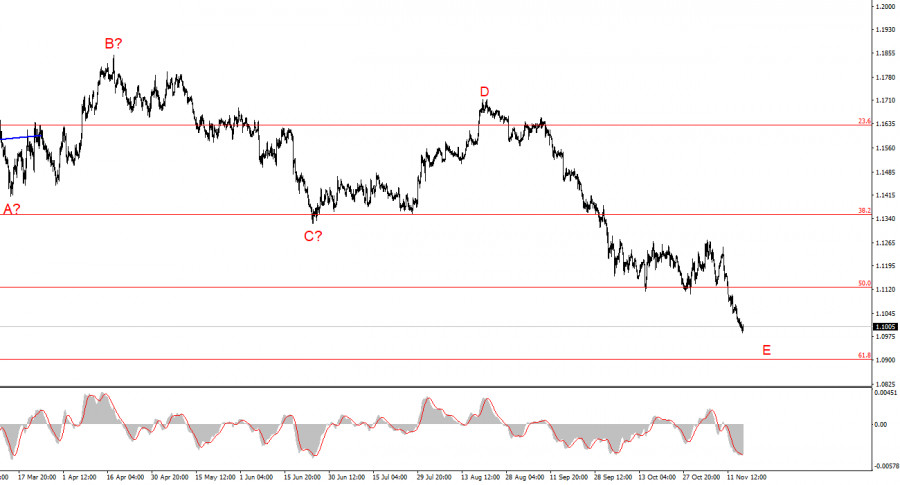
Based on the EUR/USD analysis, the pair remains within the global corrective trend segment A-B-C-D-E. However, this structure appears to be fully developed and could be completed at any moment. In the current situation, it may be a good time not only to consider buying the euro but also to anticipate the beginning of a full-fledged upward trend segment. According to the higher timeframe, the pair is expected to rise to at least the 1.1700–1.1800 level. The deeper the current decline, the stronger the subsequent advance could be. However, confirmation is needed that the formation of the downward wave sequence has been completed. One possible signal would be a failed attempt to break below the 1.0902 level, which corresponds to the 61.8% Fibonacci retracement level on the higher timeframe.
The higher timeframe shows a downward trend segment that has taken the form of an A-B-C-D-E structure. The internal wave structure of wave E has developed into a five-wave impulsive pattern, which may already be complete. If this assumption is correct, the formation of a new upward trend segment will begin soon.

SZYBKIE LINKI
ForexMart is authorized and regulated in various jurisdictions.
(Reg No.23071, IBC 2015) with a registered office at First Floor, SVG Teachers Co-operative Credit Union Limited Uptown Building, Corner of James and Middle Street, Kingstown, Saint Vincent and the Grenadines
Restricted Regions: the United States of America, North Korea, Sudan, Syria and some other regions.







 Skontaktuj się z ForexMart