The EUR/USD pair slid sharply on Friday, calling into question the upside momentum. Last week was packed with fundamental events, but the market had plenty of time to price them
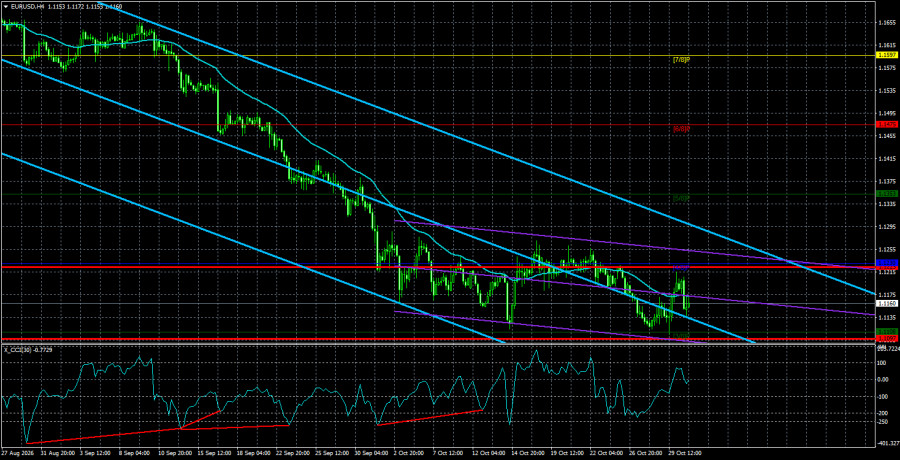
The EUR/USD pair slid sharply on Friday, calling into question the upside momentum. Last week was packed with fundamental events, but the market had plenty of time to price them in, so we didn't see a strong, sustained reaction — volatility measures confirm the market traded very listlessly.
In effect, the Federal Reserve and the European Central Bank had little impact on trader sentiment. Although both central banks left policy rates unchanged, the market continues to breathe heavily toward the dollar and shrug at the euro. New protests and riots in France and other EU countries over the weekend give anyone inclined to keep selling the euro fresh reasons to do so. We continue to view the euro's current decline as illogical and unjustified.
As noted, both the Fed and the ECB held rates last week — an outcome that in itself should not have uniquely supported either currency. In aggregate, neither currency gained over the week. Yet (and here is the paradox) the dollar has been rising for two months in a row. The market keeps working through Fed tightening while largely ignoring ECB tightening. How long that imbalance will persist is unclear.
The market is seeing only negatives for the euro — Friday provided another example. Traders noted slower German inflation but did not reward Germany's GDP growth. The market factored in a soft EU unemployment print while ignoring a strong GDP print. So if the market is positioned to keep selling EUR/USD, neither macro data, nor geopolitics, nor fundamentals will stop it. Recall market participants — especially market-makers — do not have to trade in strict accordance with macro reports or fundamentals.
This week brings many globally important events. Start with the U.S. midterms, where Trump's party is widely expected to lose control of at least one chamber. The president has already begun preparing his rhetoric, saying he will accept results only "if they are fair." If Republicans lose, he has signaled he may declare the vote fraudulent. Markets will not be able to ignore that. Immediately after the midterms, Trump could order new strikes on Iran, which would provoke further attacks across the Middle East — an argument the market could use to buy dollars. In addition, key U.S. labor-market reports and unemployment data are due this week. Again: the euro is trading illogically, so any fundamental, macro or geopolitical story can be used to justify dollar buying.
Technically, on the 4-hour timeframe, EUR/USD remains at an 18-month low. We see no signs that the downtrend is ending. The pound sterling, by contrast, is trading much more logically and technically.
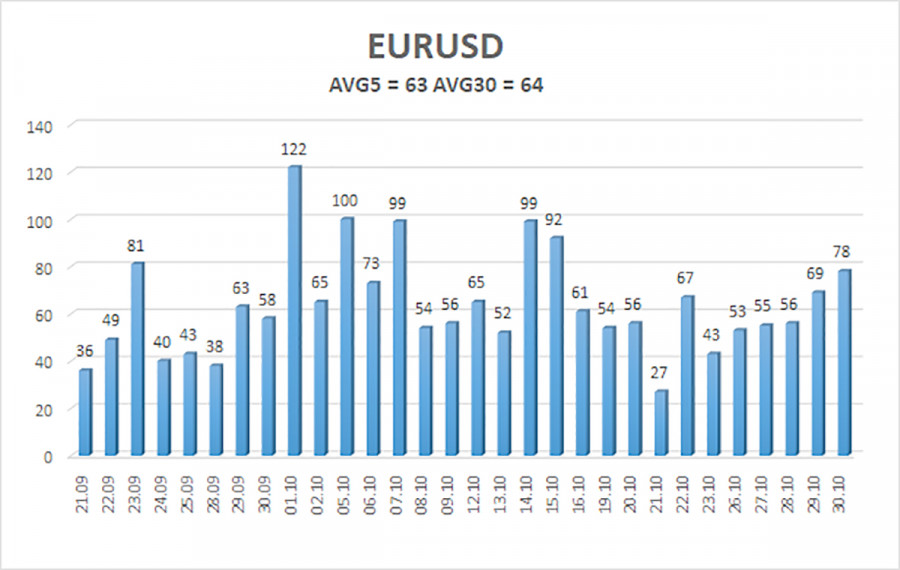
The average volatility of the EUR/USD pair over the last 5 trading days as of November 2 is 63 pips, characterized as "average." We expect the pair to trade between 1.1097 and 1.1223 on Monday. The higher linear-regression channel has turned down, indicating another trend change. The CCI entered the oversold area five times and formed four bullish divergences — all of which traders have ignored. The illogical decline continues.
S1 – 1.1108
S2 – 1.0986
S3 – 1.0864
R1 – 1.1230
R2 – 1.1353
R3 – 1.1475
EUR/USD continues to move downward, but we still view the decline as a correction before a new uptrend. The global fundamental backdrop for the dollar remains unfavorable, but in 2026, geopolitics first and then the Fed's hawkish stance have provided strong support for the U.S. currency. When price is below the moving average, consider short positions with targets at 1.1108 and 1.1097. Above the moving average, long positions are relevant with targets at 1.1230 and 1.1353.
SZYBKIE LINKI
ForexMart is authorized and regulated in various jurisdictions.
(Reg No.23071, IBC 2015) with a registered office at First Floor, SVG Teachers Co-operative Credit Union Limited Uptown Building, Corner of James and Middle Street, Kingstown, Saint Vincent and the Grenadines
Restricted Regions: the United States of America, North Korea, Sudan, Syria and some other regions.







 Skontaktuj się z ForexMart