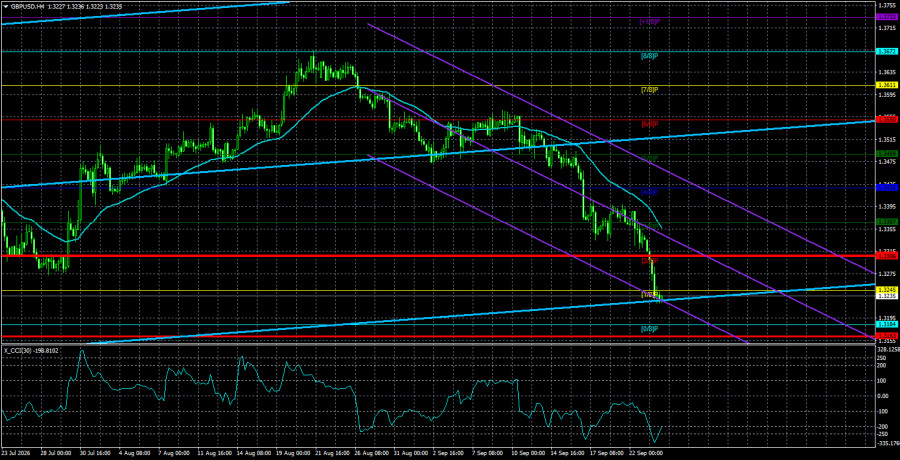
The GBP/USD pair continued its downward move on Wednesday, and it has now lasted a month. Were there new reasons for the market to sell the pound and buy the dollar? Yes, if you completely ignore all factors positive for the British pound. Let's do a simple, straightforward analysis. The US currency rises almost every day even after the Federal Reserve has already tightened policy and signaled two more rate hikes in 2026 and 2027. In other words, the market is content to expect only two more tightenings and buy the dollar every day for at least three weeks. And the Bank of England? The BoE also intends to raise the key rate twice: at the end of 2026 and the beginning of 2027. So both the Fed and the BoE are preparing to conduct two more rounds of tightening, yet only the dollar is rising. Why? Because.
As we have said many times, markets often experience periods of illogical movement. This is simple: price is determined by supply and demand, and nothing else. Fundamental events, macro data releases, geopolitical conflicts — these are just news triggers. Market participants can choose whether to react. What is happening in the FX market now fits this model perfectly. The dollar rises almost every day on the same single factor. All other factors are ignored.
We believe that in such circumstances one should call things by their names rather than disregard inconvenient facts. Thus, the current movement is entirely technical and illogical, even from a technical standpoint. Recall that on the weekly TF a four-year uptrend persists. On the daily TF, a year-long flat remains. So, in the long term the pound should appreciate, not the dollar. And if the problem were only Fed monetary policy...
US government debt continues to grow; investors increasingly demand extra compensation for risk when dealing with US securities (which puts additional pressure on the budget and sovereign debt); the US stock market has been inflating like a soap bubble for several years, and now almost everyone predicts its collapse. Donald Trump's trade policies have not brought notable benefits to the US economy; they mostly collect money from Americans themselves. The US president's approval rating has fallen to "below the floor." The war with Iran logically increased demand for the US currency, but now reports are everywhere that the conflict could be resolved soon. As a result, for example, oil prices have fallen for two weeks in a row. Yet the dollar does not react to any of these developments. It rises despite everything and for any reason. So if the BoE holds an emergency meeting tomorrow and announces an immediate 2% hike in the key rate, don't be surprised by a new drop in the British pound.
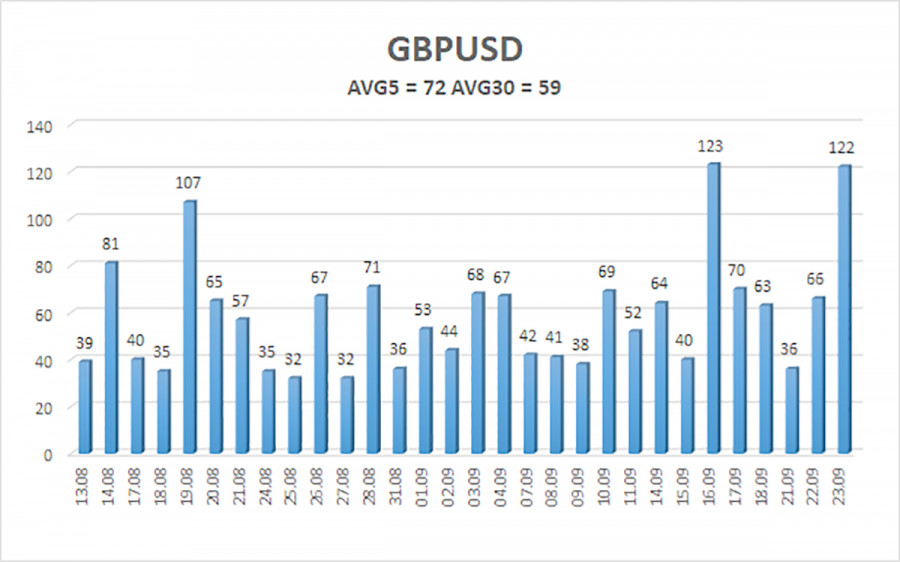
The average volatility of the GBP/USD pair over the last 5 trading days is 72 pips. For the pound/dollar pair, this value is characterized as "average." On Thursday, September 24, we therefore expect movement within the range of 1.3163 to 1.3307. The higher linear regression channel is pointing upward, indicating an uptrend. The CCI indicator has entered the oversold area twice, warning of a possible end to the downward trend.
S1 – 1.3184
S2 – 1.3123
S3 – 1.3062
R1 – 1.3245
R2 – 1.3306
R3 – 1.3367
The GBP/USD pair continues its illogical downward movement. Trump's policies will continue to pressure the US economy, so we do not expect long-term gains from the US dollar. 2026 has been positive for the dollar so far due to geopolitics and inflation, which forced capital to seek refuge and prompted the Fed to return to tightening monetary policy. However, on the weekly TF, a flat range between 1.3150 and 1.3780 persists within a four-year uptrend, which allows for expecting pound appreciation in the medium term. Consider long positions with targets of 1.3428 and 1.3489 when price is above the moving average. Price below the moving average allows bearish trading, with targets of 1.3184 and 1.3163.
Regression channels help determine the current trend. If both are directed in the same direction, it means the trend is currently strong;
The moving average line (settings 20,0, smoothed) defines the short-term trend and the direction in which trading should be conducted at present;
Murray levels are target levels for moves and corrections;
Volatility levels (red lines) are the probable price channel within which the pair will spend the next 24 hours based on current volatility indicators;
The CCI indicator – its entry into the oversold area (below -250) or the overbought area (above +250) indicates that a trend reversal in the opposite direction is approaching.

SZYBKIE LINKI
ForexMart is authorized and regulated in various jurisdictions.
(Reg No.23071, IBC 2015) with a registered office at First Floor, SVG Teachers Co-operative Credit Union Limited Uptown Building, Corner of James and Middle Street, Kingstown, Saint Vincent and the Grenadines
Restricted Regions: the United States of America, North Korea, Sudan, Syria and some other regions.









 Skontaktuj się z ForexMart