(Reuters) – Evropské akcie ve čtvrtek uzavřely vyšší poté, co Evropská centrální banka podle očekávání ponechala úrokové sazby beze změny, zatímco investoři uvítali silné výsledky velkých bank a uvolnění obchodních napětí se Spojenými státy.
Celoevropský index STOXX 600 uzavřel seanci o 0,2 % vyšší, poté co dříve dosáhl šestitýdenního maxima.
Akcie se však z maximálních hodnot stáhly, protože investoři přehodnotili své očekávání ohledně budoucího uvolnění měnové politiky poté, co prezidentka ECB Christine Lagardeová uvedla, že před rozhodnutím o dalším snížení úrokových sazeb budou tvůrci politiky pečlivěji sledovat vývoj obchodních vztahů a jejich dopad na ekonomiku.
Tento posun v náladě se odrazil na trzích s úrokovými futures, kde obchodníci omezili sázky na zářijové snížení sazeb. Výnos dvouletých německých dluhopisů také prudce vzrostl, což tížilo akciové trhy. [EUR/GVD]
The EUR/USD currency pair showed slightly higher volatility on Friday than earlier in the week. However, look at the volatility chart: Thursday moved 47 pips, Wednesday 43 pips, and Friday, with its Nonfarm Payrolls and unemployment, 58 pips. So calling Friday highly volatile is an overstatement. What does this tell us? Only that traders formally processed the Nonfarm Payrolls report, showing that it does not currently determine the dollar's fate.
What did Nonfarms show? In August, 162,000 jobs were created, and the previous two months were revised up. One might think the path to a stronger dollar is open. But it's not so simple. The market filters every report through the prism of Federal Reserve monetary policy. We keep repeating: given current conditions, the odds of Fed tightening are very low. This is supported by the frankly neutral stance of many FOMC members, slowing inflation in recent months, and the figure of Kevin Warsh, who is known as a Trump protege.
Donald Trump constantly demands lower rates. We are convinced that when Warsh was appointed Fed Chair, there was an understanding that monetary policy would be adjusted to the White House's preferences. It remains to be seen whether a suitable moment can be found to avoid casting a shadow on Warsh himself and to preserve public trust in the central bank. It seems the time for rate cuts has not come, but a rate hike is politically difficult for Trump or Warsh. Thus we still believe the rate will not be raised under almost any circumstances.
How does Nonfarm fit into this? It complicates Warsh's task: if the labor market is recovering, attention must focus on inflation, which still significantly exceeds the target. But look at Nonfarm data for the whole of 2026, not a single month. The labor market remains sluggish and only occasionally posts decent numbers. There is no guarantee that August's 162k won't fall to 100k or less in October, nor that September will produce strong payrolls. Therefore, we cannot say the labor market has recovered. If so, a strong Nonfarm print does not change the Fed's policy outlook, at least for September. That is why demand for the US currency did not increase, and next week US inflation prints — also critical for the Fed — will be released.
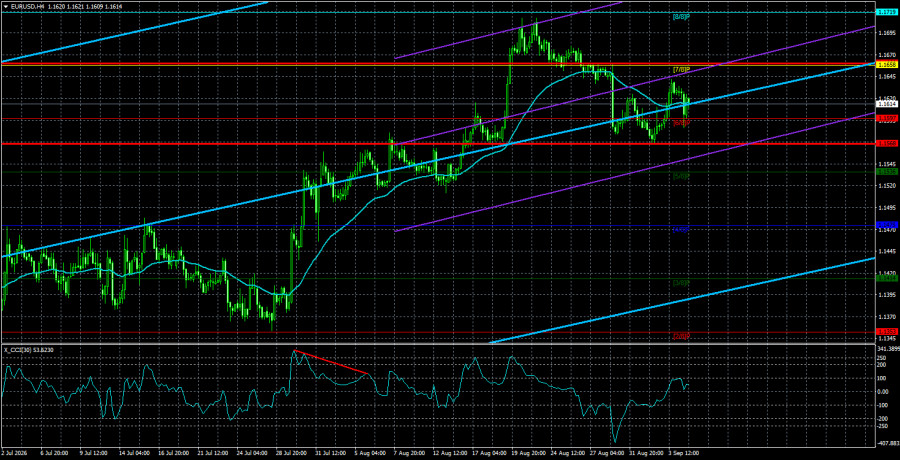
Average volatility of the EUR/USD pair over the last 5 trading days as of September 7 is 46 pips, characterized as "mid-low." We expect the pair to move between 1.1568 and 1.1660 on Monday. The major linear regression channel has turned up, indicating an upward trend. The CCI indicator entered oversold territory, warning of a possible end to the correction.
S1 – 1.1597
S2 – 1.1536
S3 – 1.1475
R1 – 1.1658
R2 – 1.1719
R3 – 1.1780
The EUR/USD pair continues its upward trend on the 4-hour TF, which may mark the start of a new leg of a global uptrend on higher TFs. The global fundamental backdrop for the dollar remains negative, although in 2026 geopolitics and then a hawkish Fed stance provided strong support for the US currency. Those factors no longer support the dollar now. If price is below the moving average, consider short positions on corrective grounds with targets at 1.1568 and 1.1536. Above the moving average, long positions remain relevant with targets at 1.1658 and 1.1719.

SZYBKIE LINKI
ForexMart is authorized and regulated in various jurisdictions.
(Reg No.23071, IBC 2015) with a registered office at First Floor, SVG Teachers Co-operative Credit Union Limited Uptown Building, Corner of James and Middle Street, Kingstown, Saint Vincent and the Grenadines
Restricted Regions: the United States of America, North Korea, Sudan, Syria and some other regions.









 Skontaktuj się z ForexMart