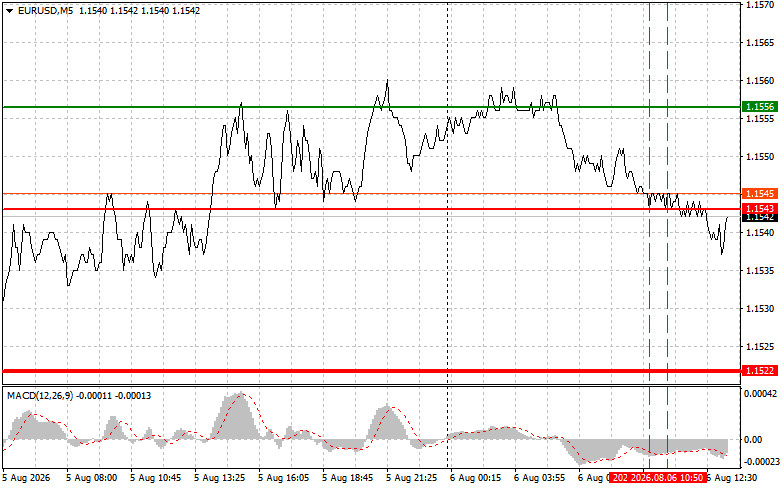
The test of the 1.1545 level occurred when the MACD indicator had already moved well below the zero line, limiting the pair's downward potential. A second test of 1.1545 triggered Buy Scenario No. 2, but the euro failed to gain upward momentum.
Mixed economic data from the eurozone weighed on the euro and triggered a pullback despite Germany's seemingly strong report. German industrial orders rose by 3.1% month-over-month in June, but the increase was driven entirely by large one-off contracts. The decisive factor for the euro was the eurozone retail sales report, which determined the currency's downward direction. Retail sales fell by 0.3% in June after increasing by 0.4% in May, with the decline spread across a broad range of member states. Since retail sales are a key indicator of consumer demand, the weak report reinforced concerns about the resilience of the eurozone economy and put additional pressure on EUR/USD.
The euro is expected to trade in a relatively calm environment during the second half of the day, as the only scheduled U.S. release is the weekly Initial Jobless Claims report. This indicator is considered an important leading measure of labor market conditions because it quickly reflects changes in layoffs. However, in the absence of other major economic releases, it rarely triggers a sharp market reaction. Markets expect the data to come in broadly in line with forecasts, making any major surprise unlikely. The U.S. dollar is therefore expected to maintain its upward momentum, which could renew pressure on EUR/USD.
For my intraday trading strategy, I will mainly rely on Scenario No. 1 and Scenario No. 2.
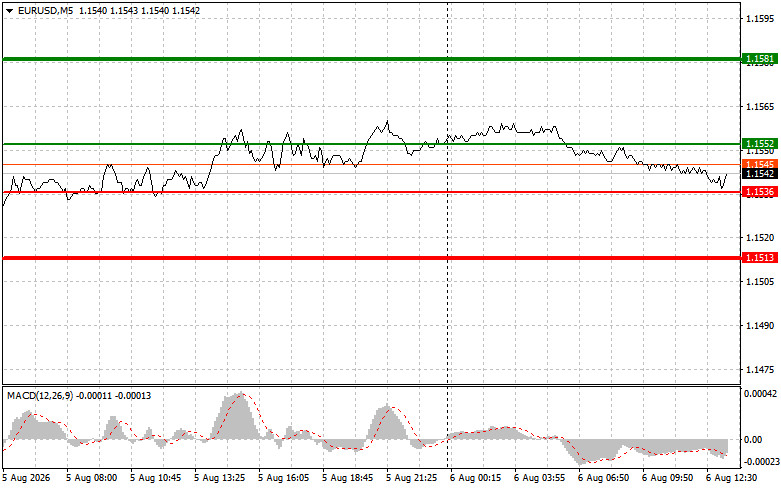
Scenario No. 1: Consider buying the euro if the price reaches 1.1536 (green line on the chart), with a target at 1.1552. I plan to exit long positions at 1.1552 and simultaneously consider opening short positions, anticipating a 30–35 point pullback from the entry point. A stronger euro can be expected today if U.S. economic data come in weaker than expected.
Important: Before entering a long position, make sure the MACD indicator is above the zero line and has just begun to move higher.
Scenario No. 2: I also plan to buy the euro if the 1.1536 level is tested twice in succession while the MACD indicator is in oversold territory. This would limit the pair's downward potential and signal a bullish market reversal. In this case, a move toward 1.1552 and 1.1581 can be expected.
Scenario No. 1: I plan to sell the euro after the price reaches 1.1536 (red line on the chart). The downward target is 1.1513, where I intend to close short positions and immediately consider opening long positions, anticipating a 20–25 point rebound. Pressure on the pair is likely to return if the U.S. data prove stronger than expected.
Important: Before entering a short position, make sure the MACD indicator is below the zero line and has just begun to move lower.
Scenario No. 2: I also plan to sell the euro if the 1.1552 level is tested twice consecutively while the MACD indicator is in overbought territory. This would limit the pair's upward potential and signal a bearish market reversal. A decline toward 1.1536 and 1.1513 can then be expected.
Beginner Forex traders should exercise extreme caution when making trading decisions. It is generally advisable to stay out of the market ahead of major economic releases to avoid sharp price swings. If you choose to trade during news events, always use stop-loss orders to limit potential losses. Trading without stop-loss orders can quickly result in substantial losses, especially when trading large position sizes without proper risk management.
Finally, remember that successful trading requires a well-defined trading plan, such as the one outlined above. Making spontaneous trading decisions based solely on current market conditions is generally a losing strategy for intraday traders.
RYCHLÉ ODKAZY
ForexMart is authorized and regulated in various jurisdictions.
(Reg No.23071, IBC 2015) with a registered office at First Floor, SVG Teachers Co-operative Credit Union Limited Uptown Building, Corner of James and Middle Street, Kingstown, Saint Vincent and the Grenadines
Restricted Regions: the United States of America, North Korea, Sudan, Syria and some other regions.









 Kontaktujte nás